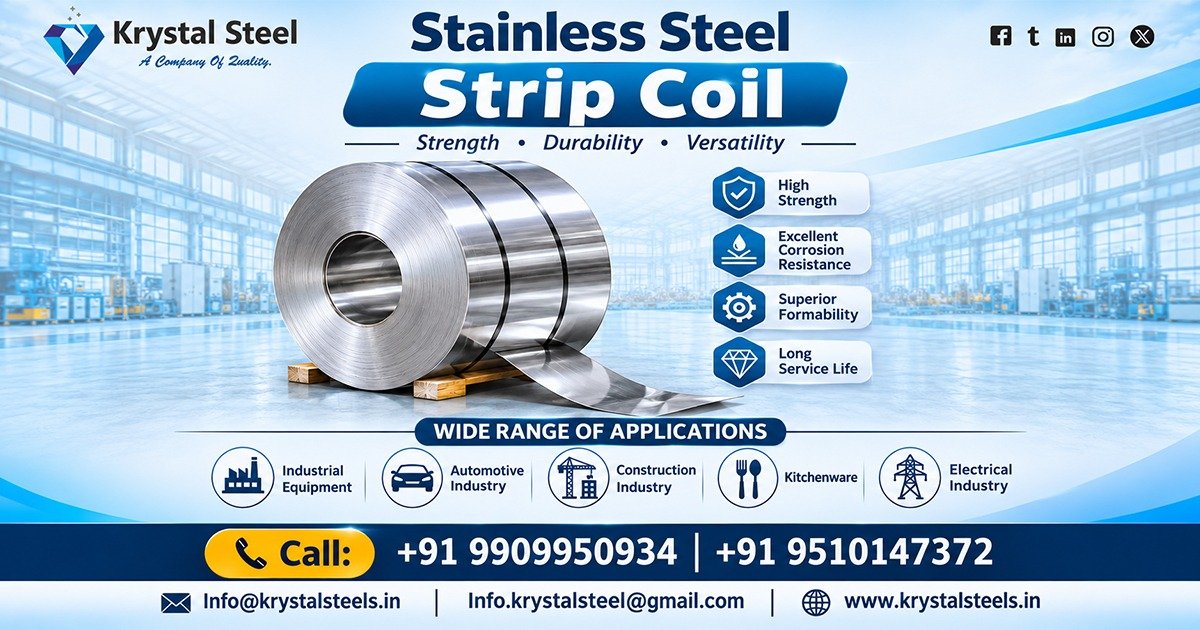
Industrial strip coils must maintain consistent thickness, surface finish, and material properties to support accurate fabrication and component production. SS 304 and SS 316 SS Strip Coils for Industrial Applications help manufacturers meet different corrosion-resistance and processing requirements, with support from Krystal Steels in Ahmedabad, Gujarat.
Understanding the Difference Between SS 304 and SS 316 Strip Coils
SS 304 and SS 316 are austenitic stainless steel grades commonly used in industrial manufacturing. Although both offer corrosion resistance and fabrication flexibility, their chemical compositions make them suitable for different operating environments.
- SS 304 Strip Coils: A general-purpose stainless steel option used for fabricated components, equipment parts, enclosures, kitchen equipment, and industrial assemblies.
- SS 316 Strip Coils: Contains molybdenum, which improves resistance to corrosion, particularly in chloride-containing and certain chemical environments.
The main difference is the operating environment. SS 304 is suitable for many general industrial applications, while SS 316 is often considered when exposure to moisture, salts, or aggressive process chemicals requires additional corrosion resistance.
Where Stainless Steel Strip Coils Fit Into Manufacturing Processes
Strip coils are supplied in continuous rolled form and can be processed into narrow strips or individual components according to production requirements.
Their form makes them useful for manufacturers working with repetitive cutting, forming, stamping, and fabrication operations.
Common industrial applications include:
- Automotive components: Brackets, clips, trim parts, and formed metal components.
- Electrical equipment: Enclosures, contact components, and supporting assemblies.
- Chemical processing: Fabricated fittings, equipment components, and corrosion-resistant parts.
- Food processing equipment: Machine covers, fabricated sections, and equipment components.
- Engineering industries: Precision-formed parts, fasteners, and industrial assemblies.
- Construction equipment: Fabricated accessories, supports, and architectural components.
The final application should determine the stainless steel grade, thickness, width, and surface finish.
Selecting the Right Grade, Thickness and Coil Width
A material mismatch can create difficulties during forming, welding, or service. Buyers should evaluate the actual manufacturing process rather than selecting a coil based only on its purchase price.
Consider these points before ordering:
1. Grade selection
- Select SS 304 for general industrial fabrication and moderately corrosive environments.
- Consider SS 316 for applications involving chlorides or more demanding corrosion conditions.
- Check the actual chemical exposure before finalizing the grade.
2. Thickness requirements
Strip thickness affects component strength, flexibility, forming behaviour, and finished dimensions. Confirm the required thickness based on the component drawing and manufacturing process.
3. Coil width
The width should match the cutting, slitting, stamping, or forming equipment. Incorrect width selection can increase material wastage.
4. Surface finish
Discuss whether the application requires a particular finish, such as bright, matte, or another specified surface condition.
5. Production requirements
Consider the following:
- Monthly material consumption
- Coil weight and handling capacity
- Slitting requirements
- Forming and bending operations
- Storage arrangements
- Future production requirements
How Strip Coils Move Through an Industrial Production Line
The manufacturing process depends on the finished component and available machinery. However, stainless steel strip coils generally pass through several stages before becoming finished industrial parts.
Step 1 – Coil Inspection
Check the material identification, grade documentation, thickness, width, and visible surface condition.
Step 2 – Uncoiling
The coil is positioned on suitable uncoiling equipment to feed the strip into the production line.
Step 3 – Slitting or Cutting
If narrower strips or individual blanks are required, the material is processed using suitable cutting or slitting equipment.
Step 4 – Forming and Fabrication
The prepared strip may undergo stamping, bending, rolling, welding, or other operations depending on the component design.
Step 5 – Final Inspection
Check the finished dimensions, edges, surface condition, and suitability for the next manufacturing stage.
Proper material identification throughout these stages helps prevent grade mixing and production errors.
Quality Checks That Matter Before Accepting a Coil Shipment
A coil may look acceptable externally but still require dimensional and documentation checks before entering production.
Procurement teams should verify:
- Grade identification: Confirm whether the supplied material is SS 304 or SS 316.
- Chemical composition: Review the material test certificate against the purchase specification.
- Thickness consistency: Measure at suitable locations across the material.
- Width tolerance: Confirm that the supplied width matches the agreed requirement.
- Surface condition: Look for scratches, dents, stains, and handling damage.
- Edge condition: Check for burrs or irregular edges that could affect further processing.
- Coil condition: Inspect packaging, deformation, and signs of moisture exposure.
- Documentation: Match material identification and certificates with the purchase order.
For critical applications, buyers should establish the required inspection and acceptance criteria before dispatch.
Storage, Handling and Production Issues to Watch
Stainless steel coils require appropriate storage and handling to preserve their surface condition and prevent unnecessary material damage.
Common problems and practical checks include:
| Common Issue | Possible Cause | Practical Check |
| Surface scratches | Improper handling or contact with hard surfaces | Inspect handling equipment and storage arrangements |
| Edge deformation | Incorrect lifting or handling | Check coil support and lifting methods |
| Rust staining | Contamination or moisture exposure | Review storage conditions and material handling |
| Uneven strip feeding | Incorrect alignment or coil setup | Check line alignment and feeding arrangements |
| Forming cracks | Incorrect grade, thickness, or forming conditions | Review material specifications and forming parameters |
| Material wastage | Incorrect width or cutting plan | Compare coil dimensions with production drawings |
Storage recommendations:
- Keep coils in a clean and dry storage area.
- Use suitable supports to prevent deformation.
- Avoid direct contact with carbon steel dust and other contaminants.
- Use appropriate lifting equipment.
- Maintain clear identification for different stainless steel grades.
- Follow suitable handling practices to protect the surface finish.
Maintenance of uncoiling, slitting, and processing equipment should follow the equipment manufacturer’s recommendations.
Services
- Stainless steel grade and material requirement consultation.
- Strip coil selection based on thickness, width, and application.
- Industrial material sourcing and order coordination.
- Product specification and procurement assistance.
Planning Industrial Material Requirements With Krystal Steels
Selecting the correct stainless steel strip involves more than comparing SS 304 and SS 316 prices. Buyers must also consider material specifications, processing requirements, and the conditions in which the finished component will operate.
Krystal Steels provides industrial steel material support for buyers evaluating stainless steel requirements. With manufacturing support from Ahmedabad, Gujarat, India, the company can be approached for product enquiries and material requirement discussions.
Visit https://krystalsteels.in/ to explore the company and discuss your stainless steel requirements.
Location
Industrial manufacturers across Gujarat require stainless steel strip materials for fabrication, engineering, machinery production, and component manufacturing. SS 304 and SS 316 SS Strip Coils for Industrial Applications are relevant to procurement requirements in Ahmedabad, Vadodara, Surat, Rajkot, Jamnagar, Bhavnagar, Gandhinagar, Bharuch, Ankleshwar, Vapi, Valsad, Morbi, Mehsana, Kalol, Sanand, Halol, Savli, Dahej, Kutch, Mundra, Porbandar, Junagadh, and Gondal.
Frequently Asked Questions
Q: What is the main difference between SS 304 and SS 316 strip coils?
A: SS 316 contains molybdenum, which improves its resistance to certain corrosive environments, particularly those involving chlorides. SS 304 is commonly used for general-purpose industrial fabrication.
Q: Which stainless steel grade is suitable for chemical processing equipment?
A: The selection depends on the chemicals, concentration, temperature, and exposure conditions. SS 316 may be suitable for more demanding environments, but compatibility should be verified for the actual process.
Q: Can stainless steel strip coils be used for precision stamping?
A: Yes. Stainless steel strips can be used for stamping and forming components. Buyers should confirm thickness, width, material condition, surface finish, and forming requirements.
Q: What documents should buyers request when purchasing stainless steel coils?
A: Buyers should request material test certificates and relevant product documentation. Grade, chemical composition, dimensions, and batch identification should match the purchase specifications.
Conclusion
SS 304 and SS 316 strip coils support a wide range of industrial fabrication and component manufacturing requirements. Selecting the correct grade, dimensions, and surface condition helps avoid processing difficulties and material wastage. Buyers across Ahmedabad and Gujarat can discuss their requirements with Krystal Steels for suitable material planning.
Planning to purchase stainless steel strip coils for your industrial production?
Contact Krystal Steels to discuss SS 304 and SS 316 material requirements, compare specifications, and get assistance with product selection and procurement planning.
Visit: www.krystalsteels.in
Email: info.krystalsteel@gmail.com
Call: +91 99099 50934 +91 95101 47372
View Product: Click Here