Industrial piping systems require fittings that can handle operating pressure, temperature variations, and process conditions. Businesses searching for an Industrial Stainless Steel Fittings Supplier In Telangana need suitable components for dependable pipeline connections and long-term industrial use.
How Stainless Steel Fittings Support Industrial Pipeline Connections
Stainless steel fittings are connecting components used to join, redirect, branch, reduce, or terminate sections of industrial piping. They help create a pipeline layout that matches the movement and handling requirements of different fluids and gases.
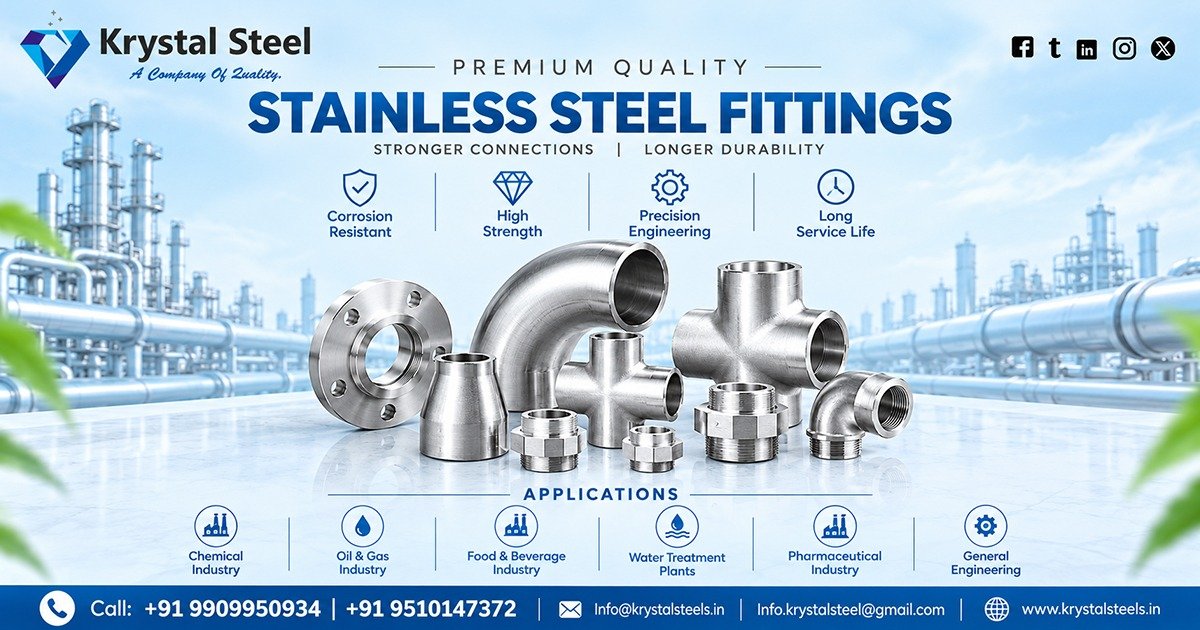
Depending on the pipeline design, commonly used fittings include:
- Elbows: Change the direction of pipeline flow.
- Tees: Create branch connections from the main pipeline.
- Reducers: Connect pipes with different diameters.
- Couplings: Join two pipe sections.
- Unions: Allow convenient disconnection during maintenance.
- Caps and Plugs: Close unused pipeline ends.
- Flanges: Provide detachable connections between piping components and equipment.
The correct fitting type depends on the pipeline arrangement, connection method, and operating conditions.
Matching Fitting Material With the Fluid and Operating Environment
Stainless steel selection should be based on the actual service environment rather than appearance alone. Different grades offer different levels of corrosion resistance, mechanical properties, and suitability for industrial conditions.
| Stainless Steel Grade | General Characteristics |
| SS 304 | Commonly used for general industrial and processing environments |
| SS 304L | Lower carbon variant of SS 304 |
| SS 316 | Contains molybdenum for improved resistance to certain corrosive environments |
| SS 316L | Lower carbon variant of SS 316 |
Before finalizing a grade, buyers should consider:
- Chemical composition of the fluid.
- Chloride exposure and corrosion risks.
- Operating temperature.
- Pressure conditions.
- Cleaning chemicals and sanitation requirements.
- Outdoor or indoor installation environment.
For aggressive chemical applications, material compatibility should be verified by a qualified technical professional.
Understanding How Industrial Fittings Are Selected and Connected
A piping system generally requires several fitting types to complete its flow arrangement. Their selection and installation should follow the approved piping layout.
A typical planning sequence includes:
- Pipeline assessment: Identify the fluid, flow direction, operating pressure, and temperature.
- Connection planning: Determine where elbows, tees, reducers, and other fittings are required.
- Dimension verification: Match fitting dimensions with the connected pipe and equipment.
- Connection preparation: Confirm whether the system requires threaded, welded, socket-weld, or flanged connections.
- Installation: Fit the components according to approved engineering drawings and installation procedures.
- Inspection: Check alignment, connection quality, and leakage before putting the pipeline into operation.
Incorrect dimensions or unsuitable connection methods can create installation difficulties and affect pipeline reliability.
Technical Details to Confirm Before Placing an Industrial Order
Buyers should prepare the piping requirements before requesting quotations from an Industrial Stainless Steel Fittings Supplier In Telangana.
The following information helps reduce product selection errors:
- Fitting type: Elbow, tee, reducer, coupling, union, or other configuration.
- Nominal pipe size: Confirm the required diameter and dimensional compatibility.
- Material grade: Specify SS 304, SS 304L, SS 316, or SS 316L as required.
- Wall thickness: Check the applicable schedule or dimensional specification.
- Pressure rating: Match the fitting to the system’s design conditions.
- Connection type: Confirm threaded, butt-weld, socket-weld, or flanged requirements.
- Surface finish: Consider the process, cleaning, and hygiene requirements.
- Quantity: Calculate the requirement for the complete pipeline and future replacements.
A clear technical specification helps suppliers identify suitable products and prepare accurate quotations.
Installation Conditions That Affect Pipeline Performance
Even correctly selected stainless steel fittings can create problems when installation is not properly planned.
Before starting installation, verify these conditions:
- Pipe ends and fitting surfaces are clean and free from contamination.
- Connected components have matching dimensions and connection types.
- Pipe alignment does not place unnecessary stress on fittings.
- Welding is performed using suitable procedures and qualified personnel.
- Threaded connections use compatible sealing materials.
- Adequate clearance is available for inspection and maintenance.
- The completed pipeline is inspected and tested according to its approved design and applicable procedures.
Avoid mixing incompatible materials or using unsuitable tools that may contaminate stainless steel surfaces.
Maintenance Checks and Common Pipeline Fitting Problems
Regular inspection helps identify connection problems before they affect the larger piping system.
| Common Issue | Possible Reason | Practical Action |
| Leakage around joints | Improper sealing or connection | Inspect and rectify the joint |
| Surface rust or staining | Contamination or unsuitable environment | Identify the cause and clean appropriately |
| Loose threaded connections | Vibration or improper tightening | Inspect and secure as per procedure |
| Cracks near welded joints | Welding defects or mechanical stress | Arrange qualified inspection |
| Flow restriction | Deposits or incorrect fitting arrangement | Inspect the affected pipeline section |
Recommended maintenance practices:
- Inspect joints and external surfaces regularly.
- Clean fittings using methods compatible with the stainless steel grade.
- Check for corrosion, cracks, and visible deformation.
- Monitor leakage around threaded and welded connections.
- Maintain records of replacements and inspection findings.
Inspection frequency should depend on operating conditions, fluid characteristics, and the maintenance plan.
Quality Checks Before Finalizing a Fittings Supplier
Product appearance alone is not enough to establish whether a fitting is suitable for an industrial project. Buyers should evaluate the supplier’s ability to meet technical and documentation requirements.
Use this checklist before confirming an order:
- Verify the stainless steel grade and material identification.
- Check dimensions, wall thickness, and connection compatibility.
- Review available material test certificates where required.
- Confirm manufacturing finish and visible surface condition.
- Check dimensional consistency across the supplied batch.
- Confirm product availability and delivery commitments.
- Discuss customized dimensions or special configurations if needed.
- Understand replacement, spare supply, and technical support arrangements.
A supplier who understands the complete piping requirement can help reduce mismatches during procurement and installation.
Services
- Industrial stainless steel fitting requirement consultation and product identification.
- Material grade, dimensions, and connection selection assistance.
- Order planning and manufacturing coordination.
- Technical assistance and after-sales support for industrial requirements.
How Krystal Steels Supports Industrial Piping Requirements
Industrial projects often involve multiple fitting configurations, different material grades, and specific dimensional requirements. Krystal Steels supports buyers looking for suitable stainless steel products for their piping and infrastructure requirements.
With manufacturing support from Ahmedabad, Gujarat, India, the company can assist customers in discussing product specifications and coordinating requirements according to project needs.
Buyers can visit Krystal Steels to explore the company’s product information and discuss requirements related to:
- Stainless steel fitting types and configurations.
- Material grade and dimensional requirements.
- Industrial piping project specifications.
- Product selection and procurement planning.
For customers sourcing products for Telangana, sharing the application details and technical specifications can make the procurement discussion more effective.
Location
Telangana has industrial and infrastructure activities across pharmaceuticals, engineering, chemicals, manufacturing, food processing, and utilities. These sectors require suitable stainless steel piping components for fluid handling, process connections, and plant development. Industrial supply requirements may arise across Hyderabad, Secunderabad, Medchal, Jeedimetla, Balanagar, Patancheru, Pashamylaram, Sangareddy, Bollaram, Cherlapally, Nacharam, Uppal, Katedan, Shamshabad, Shadnagar, Maheshwaram, Genome Valley, Ramachandrapuram, Nalgonda, Warangal, Karimnagar, Khammam, Nizamabad, and Mahabubnagar.
Frequently Asked Questions
Q1: Which stainless steel grade is suitable for industrial pipe fittings?
A: SS 304 is commonly considered for general industrial applications, while SS 316 may be suitable for certain more corrosive environments. The final choice depends on fluid composition and operating conditions.
Q2: What information should buyers provide when requesting a fitting quotation?
A: Share the fitting type, material grade, pipe size, wall thickness, connection type, pressure requirements, and quantity. Drawings or technical specifications can help clarify project requirements.
Q3: Are welded and threaded stainless steel fittings interchangeable?
A: No. They use different connection methods and installation requirements. Selection should depend on pipeline design, maintenance needs, operating conditions, and engineering specifications.
Q4: How can stainless steel fitting corrosion be minimized?
A: Select a compatible material grade, prevent surface contamination, use appropriate cleaning methods, and inspect fittings regularly. Chemical exposure and chloride concentration should also be considered.
Conclusion
Reliable industrial piping depends on compatible fittings, correct material selection, accurate dimensions, and proper installation. Businesses across Telangana should evaluate operating conditions and quality documentation before procurement. Krystal Steels, with manufacturing support from Ahmedabad, Gujarat, India, can assist with industrial stainless steel fitting requirements and product selection discussions.
Contact Krystal Steels through krystalsteels.in to discuss your industrial stainless steel fitting requirements and receive product selection assistance.
Visit: www.krystalsteels.in
Email: info.krystalsteel@gmail.com
Call: +91 99099 50934 +91 95101 47372
View Product: Click Here